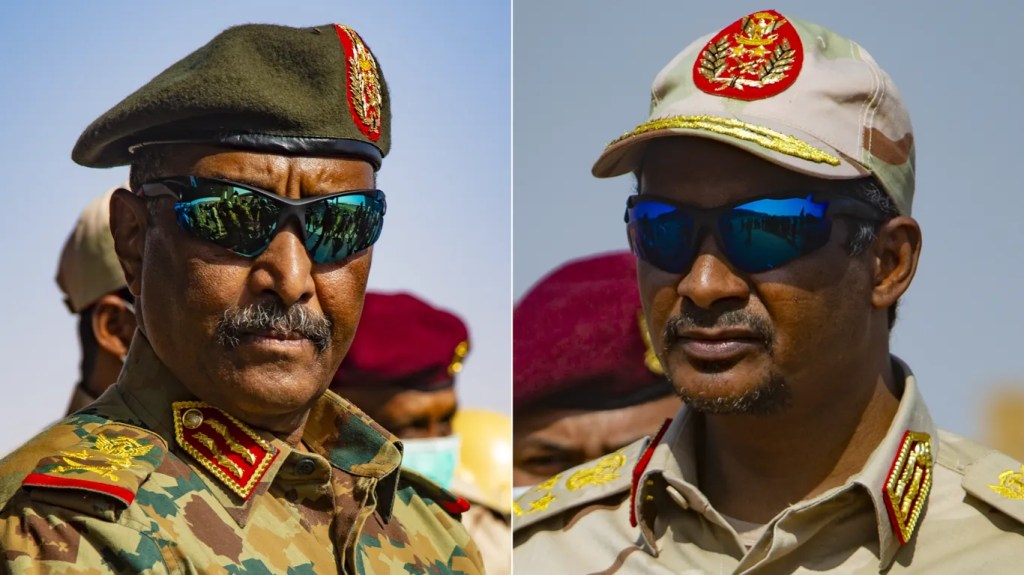
On the 6th of August 2025 a plane was shot down by the Sudanese Armed Forces (SAF) as it attempted to land at an RSF-controlled airport in the war-torn region of Darfur, West Sudan. Given the fact a brutal and bloody civil war has been raging in the country for the past 2 years, this may not seem too out of the ordinary. However, soon after the crash, it was confirmed that the plane was carrying at least 40 Colombian nationals, all men, all of fighting age. What were 40 Colombians doing smack bang in the middle of a civil war in North East Africa? The crash confirmed what most commentators have long known. Sudan’s civil war has gone international.
Sudan is the third-largest country in Africa and home to approximately 50 million people. It is also one of the most resource-rich countries on the continent. This natural wealth has become deeply entangled in the ongoing civil war, forcing foreign stakeholders to hedge their bets and back either the Sudanese Armed Forces (SAF) under the command of General Abdel Fattah al-Burhan or the Rapid Support Forces (RSF), headed up by the infamous warlord, Mohammed Hamdan Dagalo, better known as “Hemedti”. As usual, the consequences for civilians have been deadly. With over 150,000 killed already, it has become clear that the SAF, the RSF and all the foreign powers involved place more value in gold and power than they do in the lives of Sudanese citizens.
Before South Sudan’s independence in 2011, Sudan held vast amounts of oil reserves. After secession, it lost around 75% of all oil fields but crucially maintained control of pipeline routes used to export South Sudanese oil through Port Sudan. Transit fees are a big source of revenue for the SAF. Sudan also boasts some of the most fertile land in Africa along the Blue and White Nile. Gulf States such as the UAE, Saudi Arabia and Qatar have invested heavily in Sudanese farmland to secure food supply chains. There are also large deposits of Chromium, Manganese, copper, iron ore, mica, silver, and uranium scattered across Darfur, the Red Sea Hills, and Kordofan. These remain under-exploited due to the war and sanctions, but are of strategic interest to Russia, China, and Gulf investors.
But foreign powers are not going to send their own citizens to fight in a war over farmland, copper and a minimal amount of oil. What could Sudan have that governments would risk breaking international law to secure? The world’s most valuable currency. Gold.
Officially, Sudan produces around 90-100 tonnes of Gold per year, although this number is likely significantly higher, with the amount that is smuggled out. Most of the gold mines are found in Darfur, Kordofan and the Nile Valley and control of the mines is a major driver in the conflict. The RSF currently controls the majority of the mines in the country, effectively privatising Sudan’s most valuable natural resource. The group has used profits from the gold trade to fund their war effort as well as the ties built through the gold trade to secure international backing.
Rumours of Russian presence in the country through the Wagner group first began circulating in 2017. Sudan has become significant for the Kremlin since an agreement with the ousted president Omar al-Bashir to establish a Russian naval base at Port Sudan on the Red Sea, which would hold vital strategic importance. The Russians, of course, like everyone else, also have an interest in Sudan’s gold. Menroe Gold Ltd is a Sudanese company operating under the umbrella of a Russian company named M Invest Ltd. M Invest Ltd was owned by the deceased Wagner Group founder, Yevgeny Prigozh. Ownership of both M Invest Ltd and the Wagner Group is believed to have been passed to Prigozh’s son after his death.
The Wagner Group is alleged to have trained RSF forces as well as provided security for RSF-controlled gold mines. The SAF has also accused the Wagner Group of supplying weapons to the RSF. Reports from the early days of the Civil War indicated that around 500 Wagner mercenaries were operating between Sudan and the neighbouring CAR (Central African Republic), which is also in the midst of a Civil War. However, the Wagner group has maintained that as of 2021, no Wagner fighters are stationed in Sudan.
While the Wagner Group’s influence across Africa since 2017 is clear, they are not the only mercenaries operating on the continent. In fact, like most other African conflicts in the 21st century, most mercenaries fighting in the ongoing Sudan Civil War come from within the continent. The RSF recruits heavily from the Baggara and other cross-border Arab tribes across Chad, Niger and Mali. Recruiters exploit shared language, culture, and kinship to integrate fighters quickly and mercenaries are offered loot rights, cash, or livestock as payment.
According to Sudanese writer Al-Sadiq al-Raziqui, Chad has been the largest source of mercenaries for the RSF. This is due to weak borders, which allow ease of movement between the two neighbouring countries, as well as shared values and culture. RSF leader “Hemedti” originally comes from a small Chadian Arab camel-herding clan, which took refuge in Darfur in the 1980s.
The conflicts that have plagued East Africa for much of the 20th & 21st centuries have allowed the mercenary industry to thrive in the region. Foreign national mercenaries have turned up dead in civil wars across Somalia, Rwanda, Ethiopia and Congo, so it is no surprise that this is also the case in the ongoing Sudanese Civil War. Russian mercenaries also have a reputation for turning up on battlefields on the other side of the planet to do Putin’s dirty work. Colombians, on the other hand, raise a few more eyebrows when you’re tallying up the dead nationalities of this Civil War.
An internal armed conflict has plagued Colombia since the 1960s. Government forces, drug cartels, far-right paramilitaries and far-left guerrilla groups all clashing with one another in attempts to increase their influence within the country. The most intense fighting has quelled since 2016 when the far-left guerrilla group, FARC, signed a peace deal with the Colombian government. What happens when a country is in constant conflict for the best part of 60 years? Lots of soldiers and lots of ex-soldiers.
With low investment and high unemployment rates, former soldiers in Colombia have limited opportunities to make a decent living when their military careers come to an end. So when a transnational mercenary network, headed by retired Colombian Colonel, Alvaro Quijano, comes along with a job opportunity, most ex-soldiers are ready to bite his hand off.
Quijano runs his mercenary operation in partnership with Global Security Service Group, a private security firm based in the United Arab Emirates. The ex-soldiers were led to believe they would be providing security for oil drilling sites in the Middle East and Africa. They were promised a salary of $2,600USD which was enough to entice many retired military personnel to sign up. For reference, the average monthly salary in Colombia is around $850USD.
However, it would soon become clear that Quijano and his colleagues from the UAE had been selling a fantasy. After arriving in the UAE, the coerced ‘mercenaries’ were then transported to Libya, where they had their passports confiscated before being smuggled across Chad and into Sudan. The first Colombians reached Sudan in November 2024 where they quickly realised there were no oil fields to protect. Just a brutal Civil War raging all around them. They were deployed to the frontlines in the city of El Fashar, to bolster RSF forces who had been surrounding the city since May 2024.
It’s been reported that over 300 Colombian mercenaries are currently fighting in Sudan as part of an RSF battalion known as the Desert Wolves. The majority are stationed in the city of Nyala in South Darfur, the launchpad for the RSF’s bloody campaign in El Fashar. All the while, Colonel Alvaro Quijano retains control of the Desert Wolves from a penthouse suite in Dubai.
The influx of foreign mercenaries, particularly those recruited through the UAE and its associates, highlights the wider geopolitical implications of this horrendous conflict. Although they continue to deny supplying weapons and other forms of support, it is abundantly clear that the UAE has stood behind the RSF and Hemedti since the outbreak of war in 2023. This puts them at odds with one of their rival Gulf states, Egypt, which has openly endorsed al-Burhan and the SAF. Egypt have been accused by the RSF of supplying weapons and intelligence to the SAF, an allegation which they also deny. The two Gulf states have long been at odds as they vie for control and influence in the region.
Regional stability is also at risk. Sudan’s war has turned Darfur into a magnet for fighters from across the Sahel, undermining peace efforts in neighbouring Chad, Mali, and CAR. The tribal recruitment model risks cross-border insurgencies spreading into states already struggling with jihadist and separatist violence.
Although the RSF has recently agreed to a humanitarian ceasefire brokered by the US, there have already been reports of RSF drones striking the capital, Khartoum. While no one expected the ceasefire to last long, the speed with which it was broken further shows the issues with unaccountable foreign combatants. Foreign mercenaries who answer to third parties, such as the UAE, are not under the control of the RSF and may not adhere to the ceasefire terms if instructed to do so.
Sudan’s war is not simply a struggle between two generals or rival armies; it has become a contest over who controls the veins of a resource-rich nation. From the gold mines of Darfur to the oil pipelines snaking toward the Red Sea, every asset has been weaponised. The RSF’s capture of Sudan’s goldfields has transformed the conflict into a self-sustaining war economy — one financed by smuggled bullion and fought by foreign mercenaries drawn into the country’s orbit by promises of pay and power. Around these frontlines, global interests converge: Gulf monarchies securing trade routes, Russia seeking mineral leverage, and Western powers watching a humanitarian catastrophe deepen. Sudan’s tragedy, once viewed as a domestic power struggle, now stands as a mirror of a changing world order — where private armies, proxy states, and profit networks shape the future of warfare itself.
 The Underground
Leave a comment