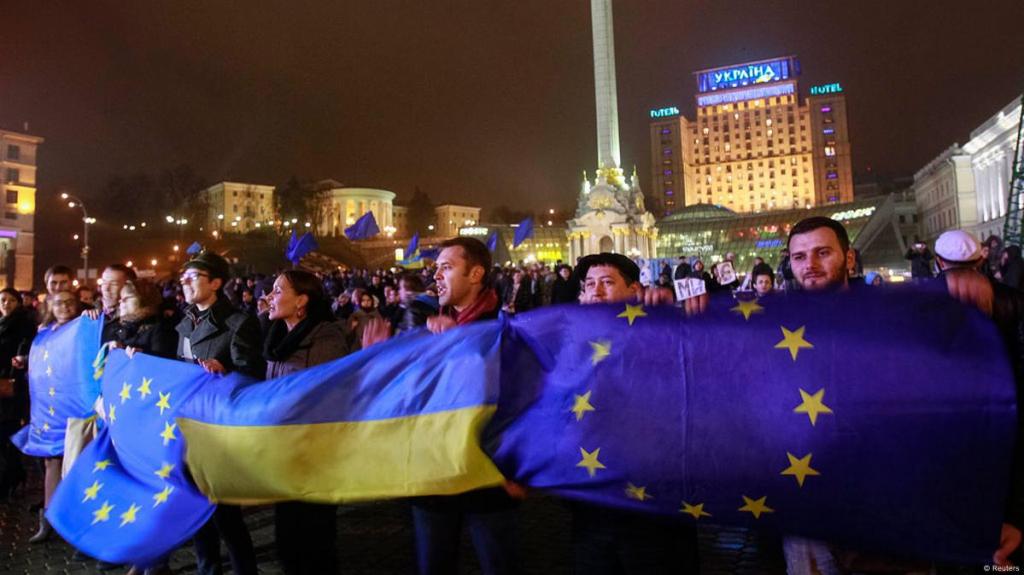
This month marks the 11 year anniversary of the beginning of the Euromaidan protests in Ukraine. The protests would spark a chain reaction that would eventually lead to the Russian invasion of Ukraine in February 2022 and the beginning of the ongoing war between the two nations.
Since the dissolution of the Soviet Union when Ukraine became an independent state, they had maintained close ties with Russia, so much so that the Ukrainian economy became integrated with the Russian economy. About a third of all Ukraine’s foreign trade was with Russia. However, another third of all of their foreign trade was with the European Union.
At the beginning of November 2013 Viktor Yanukovych was the president of Ukraine. Yanukovych was considered an ally of Valdimir Putin and under the influence of the Russian president. Despite this, the Ukrainian government had been negotiating since 2012 with the EU for a Ukraine-EU association agreement. The proposed agreement would establish a political and economic association between the parties. The main points of the agreement were to introduce regulation over workers rights, exchange of information and staff, the modernisation of Ukraine’s energy infrastructure and taking steps towards Visa free movement of people. Ukraine would also be given access to the European Investment Bank.
The EU had one condition for their agreement. That Ukraine address the “stark deterioration of democracy and the rule of law” in particular the imprisonment of multiple political opponents such as Yulia Tymoshenko and Yuriy Lutsenko. There was also concerns about government corruption, human rights violations and the influence of Russian Oligarchs.
Unsurprisingly, Vladimir Putin was not best pleased with this agreement. He saw an EU friendly Ukraine as a potential future NATO member right on his doorstep. Therefore it was a huge blow to him when the Ukrainian parliament voted overwhelmingly to approve the finalisation of the agreement. The Russian President began exerting extreme pressure on Ukraine to back out of the deal. The economic blackmail began with Russia restricting imports from Ukraine and was followed by numerous Russian institutions threatening, insulting and organising pre-emptive trade restrictions against Ukrainian businesses.
Viktor Yanukovych and the Ukrainian government were clearly feeling the pressure as they began stalling the signing of the EU agreement and increased communication with their Russian neighbours. After a three way trade deal proposed by Ukraine involving all three parties was rejected by the EU, it became clear which side the Ukrainian government were leaning towards. On the 21st of November 2013, Yanukovych backed out of the deal instead choosing stronger ties with Russia and the Eurasian Economic Union.
The Ukrainian people felt betrayed by their government and in the following days took to the streets to protest the sudden decision not to sign the agreement. A small, peaceful protest, attended by no more than 1500 people (most of them students) was dispersed violently by Berkut riot police units. Disgusted by the violent reaction of the government, on the 1st of December, more than 500,000 joined the protests in Kyiv.
It was at this point that protests became not only more organised but also more volatile as Yanukovych’s government desperately tried to oppress the protestors. Protestors organised “self-defence” groups to protect Ukrainian’s participating in the movement. These groups were supported by opposition political parties and businessmen such as Arson Avakov who created the “Maiden Self-Defence” group.
Then came the 11th December, a historical day for Ukraine. The military were called in to support Berkut police as over 400,000 protestors flooded the streets of Kyiv. When initial attempts to disperse the crowd in Maiden Square failed, a large number of reinforcements were called in for a second attempt. However, those protestors already in Maiden Square also called for a mass mobilisation of Kyiv citizens and many answered the call. Having set up makeshift barricades to establish a defensive line, unarmed citizens linked arms and held the defensive line for over 3 hours. Some protestors also managed to obtain riot shields from the Berkut and were eventually able to push them back outside the square.
The protests on the 11thDecember marked a turning point in the movement. The people of Kyiv had embarrassed the government and Yanukovych was now determined to regain control over his people. His first bright idea to do so was to introduce new Anti-Protest laws. The laws included amnesty for any Berkut Police Officers who were found to have committed crimes against protestors, allowing trial in absentia (including prison sentences), defamation through social media would now carry a sentence of at least one year in jail and jail sentences for participation in peaceful gatherings wearing a mask, camouflage clothing, scarf or helmet.
The laws were dubbed as “Dictatorship Laws” and needless to say, they ended up backfiring massively for Yanukovych and the government. Protests spread across Ukraine like wildfire with major demonstrations taking place in Lyiv, Kharkiv, Cherkasy and Tertnopil. There were even minor protests organised in places such as Donetsk and Dnipro which were traditionally Pro-Russian/Pro-Government strongholds. Under increasing pressure from both his own citizens and Valdimir Putin, Yanukovych undertook an approach that would both spell the end of his presidency and disgrace his name in the history books.
On 19th January, 200,000 protestors gathered in central Kyiv to oppose the new Anti-Protest laws. They were attempting to march from the Maiden to the parliament buildings but were blocked by Berkut police. Fierce clashes broke out on Hrushevsky Street, which led to a violent standoff that lasted 3 days. During these 3 days, Berkut Police opened fire on the crowds multiple times, resulting in the deaths of 3 protestors. Outraged at the government’s killing of its own citizens, demonstrations intensified across the country, and many government buildings were occupied by protestors. The government officially resigned, however, Yanukovych refused calls for his resignation and clung to power.
Over the next month, demonstrations continued as Yanukovych desperately tried to consolidate his power. Frustrated by his attempts, protestors called for one more mass mobilisation of citizens and on the 18th February, the call was answered. Thousands of protestors gathered in Maiden Square to once again march towards parliament. In one last disgraceful act from Yanukovych, Berkut Police snipers were ordered to fire into the crowd. Clashes continued until the 20th February, over the 3 days, nearly 100 protestors were killed by police. In total, 108 people were killed by police in January and February 2014.
On the 21st February an interim government was appointed, mainly consisting of opposition party members. Police then abandoned Kyiv and the city was now controlled by the protestors. The following day, the interim government voted to remove Yanukovych from power. On the 24th of February, Yanukovych fled to Russia. The Revolution of Dignity had begun.
Unfortunately not everyone was best pleased with the revolution. Pro-Russian, counter-revolutionary protests erupted in southern and eastern Ukraine. Crimea was then occupied and annexed by Russia and Pro-Russian separatists seized government buildings and proclaimed the independent states of Donetsk and Luhansk. This would spark the Donbas War between Ukraine and Pro-Russian separatists. The war would last 8 years until the Russian invasion of Ukraine began.
 The Underground
Leave a comment